
Last reviewed: July 23, 2026
We review this comparison regularly as winery software platforms release new features and capabilities.
Choosing the best winery software is not simply a matter of comparing feature lists.
Most winery platforms can process an order, manage a customer record or run a wine club. The larger difference is how those functions work together—and how many additional systems, integrations, vendors and manual processes the winery needs to operate its direct-to-consumer business.
A winery may have one system for ecommerce, another for wine club management, a separate tasting room POS, WordPress for its website, a reservation platform, shipping software, compliance tools, email marketing and spreadsheets for reporting.
Each individual system may work. The operational problems often appear between them.
Corksy takes a different approach. Corksy is a wine-specific operating platform that connects a winery’s website, ecommerce, wine club, POS, CRM, reservations, inventory, fulfillment workflows and reporting in one system.
That does not mean Corksy is automatically the right choice for every winery. Commerce7, OrderPort, Shopify, VinSuite and Active8 each serve different operational needs. The best winery software depends on what the winery is trying to simplify, modernize or improve.
If you’re comparing winery software, here’s the short version:
The right choice depends on your winery’s operating model, existing technology, and whether you’re looking to optimize one part of your business or simplify your entire direct-to-consumer operation.
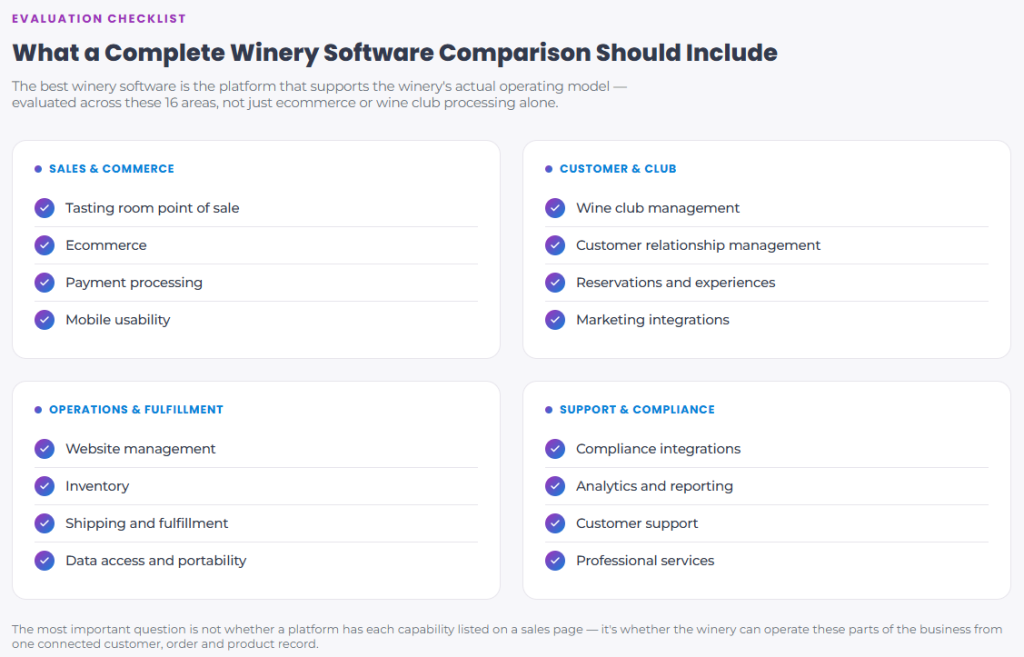
The best winery software is the platform that supports the winery’s actual operating model without creating unnecessary work between departments and systems.
For many wineries, that means evaluating more than ecommerce or wine club processing. A complete comparison should include:
The most important question is not whether a platform has each capability listed on a sales page.
The better question is:
Can the winery operate these parts of the business from one connected customer, order and product record?
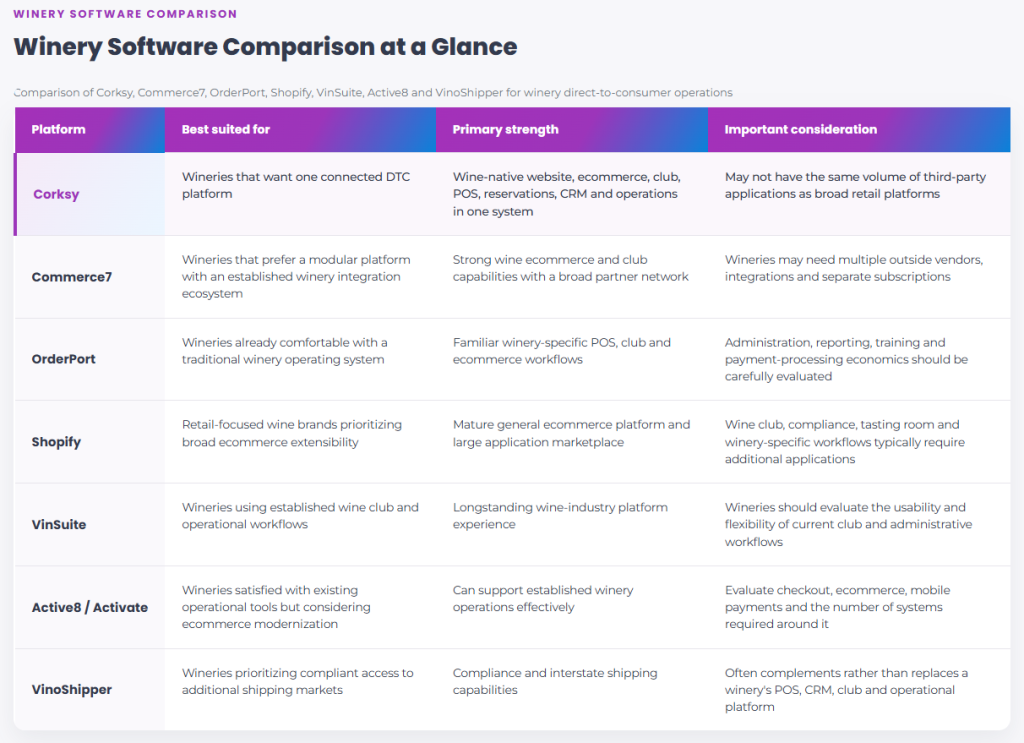
That is where Corksy’s all-in-one model differs from platforms that depend more heavily on separate website systems, applications or integration partners.
Corksy is built specifically for winery direct-to-consumer operations.
The platform connects the systems used across the tasting room, wine club, ecommerce store, website and back office. That gives staff a more complete view of the customer and reduces the number of handoffs required to complete everyday work.
A customer may buy online, join the wine club in the tasting room, make a reservation, attend an event and place a shipment order.
When those activities happen in different systems, staff may see only part of the relationship.
Corksy connects customer activity across:
This gives winery staff more context when serving customers and gives leadership a clearer picture of DTC performance.
Corksy includes a managed winery website and CMS powered by Duda.
This is different from connecting winery commerce tools to a separate WordPress site or maintaining a storefront that is largely disconnected from the operational platform.
A connected website can reduce repeated updates across systems. Product information, collections, events, club options and ecommerce experiences can be managed as part of the winery’s broader DTC operation.
The website is not treated as a separate marketing brochure. It becomes part of the system the winery uses to sell wine, acquire members and manage customer experiences.
Wine club transactions do not exist separately from tasting room and ecommerce activity.
Corksy connects:
This can reduce the need for manual exports, duplicate records and separate customer searches.
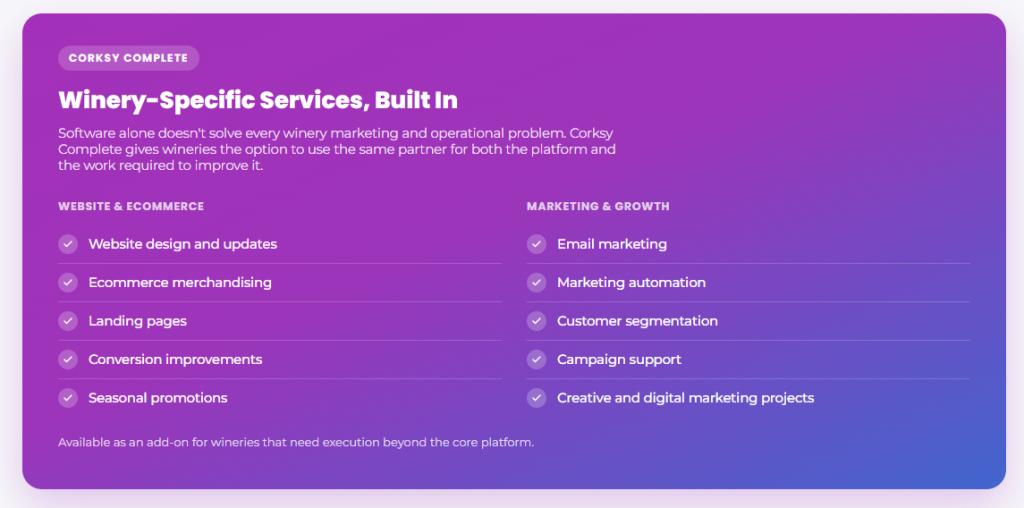
Software alone does not solve every winery marketing and operational problem.
Corksy Complete provides access to additional services such as:
This gives wineries the option to use the same partner for both the platform and the work required to improve it.
A winery POS should do more than complete a transaction.
Staff should be able to:
Corksy POS connects directly to the customer’s wine club, ecommerce and CRM record.
Corksy Go extends that functionality to a handheld winery POS with built-in connectivity, allowing staff to sell throughout the tasting room, patio, vineyard, event or off-site location.
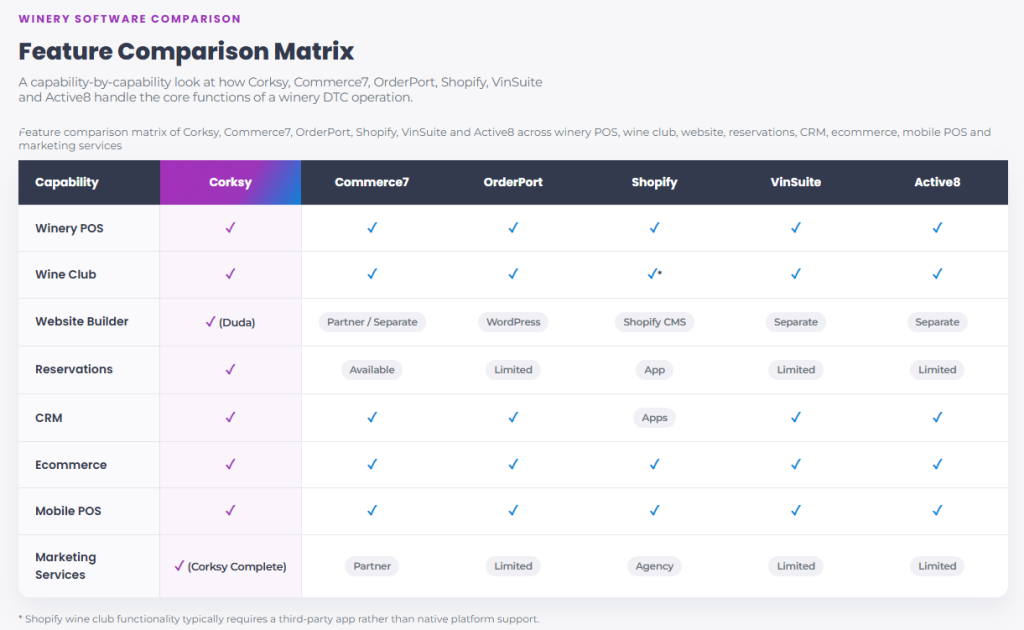
Commerce7 and OrderPort also offer winery-specific POS capabilities. Shopify offers a strong general retail POS, but wineries should evaluate how club status, compliance, member pricing and winery customer data are handled across additional applications.
The best winery POS is the one that supports how the tasting room actually serves customers—not only how it takes payment.
The best wine club software should make routine club work easier for both members and winery staff.
Important wine club features include:
Corksy connects wine club activity to POS, ecommerce, CRM and reservations.
This matters because a wine club member is not only a recurring order. The member may also visit the tasting room, attend events, make additional purchases and interact with the winery online.
Commerce7 is also a strong wine club and ecommerce platform, particularly for wineries that value its integration ecosystem.
VinSuite, OrderPort, and Active8 provide established winery club tools, but wineries should carefully compare administrative usability, customer-choice flexibility, reporting and member self-service.
Shopify typically requires one or more additional applications to support a traditional winery club model.
Winery ecommerce has requirements that general retail ecommerce does not always address natively.
These include:
Shopify is exceptionally strong as a general ecommerce platform.
Commerce7 is strong for wine-specific ecommerce supported by a partner ecosystem.
Corksy combines winery ecommerce with the broader operational system, including the website, club, POS, customer data and fulfillment workflows.
The best winery ecommerce platform depends on whether the winery prioritizes maximum retail extensibility or a more unified wine-specific operation.
A winery website needs to support more than visual branding.
It should help the winery:
Corksy websites are powered by Duda and connected to Corksy’s ecommerce and winery operating platform.
This gives wineries a modern visual website editor without separating the site from the commerce and operational systems behind it.
WordPress may offer greater plugin flexibility, but that flexibility can create maintenance, security and compatibility responsibilities.
Shopify provides a capable ecommerce website builder, although winery-specific functionality generally depends on applications.
Commerce7 can support strong winery ecommerce experiences, but many implementations involve a separate website agency or CMS relationship.
For wineries that want website management and winery operations under one provider, Corksy offers a clearer all-in-one model.
Reservations are more useful when they contribute to the customer record.
A connected reservation system can help staff understand:
Corksy includes reservations within the broader winery platform.
That gives the winery the opportunity to connect the guest’s experience to POS purchases, club activity and CRM data.
Standalone reservation systems may offer deeper hospitality-specific capabilities or marketplace exposure. They can be a better fit for wineries with highly complex experience operations.
Corksy is best positioned when the winery prioritizes a connected customer record and fewer separate systems.
A winery CRM should make customer information usable.
That includes:
Corksy keeps the core customer record connected to transactions across ecommerce, POS, club and reservations.
The platform can also connect with marketing tools such as Klaviyo and Mailchimp for campaign execution and advanced automation.
This model allows Corksy to remain the operational source of customer and transaction data while specialized marketing platforms manage messaging.
Shopify also has a strong marketing application ecosystem. Commerce7 supports multiple winery marketing integrations. The quality of the final setup depends on how reliably customer, order and club data move between the systems.
Winery reporting should help teams answer practical questions:
Corksy provides connected reporting across its operational platform.
Its advantage is that the reports draw from systems already sharing customer, order and product data.
Commerce7 is often selected by wineries that need flexible connections to specialized analytics partners.
Shopify offers mature ecommerce analytics but may require additional systems to create a complete view of club, tasting room and winery operations.
Sophisticated multi-brand, multi-location or enterprise wineries should validate every reporting requirement during the sales process. No winery should assume a standard dashboard will answer every operational question.
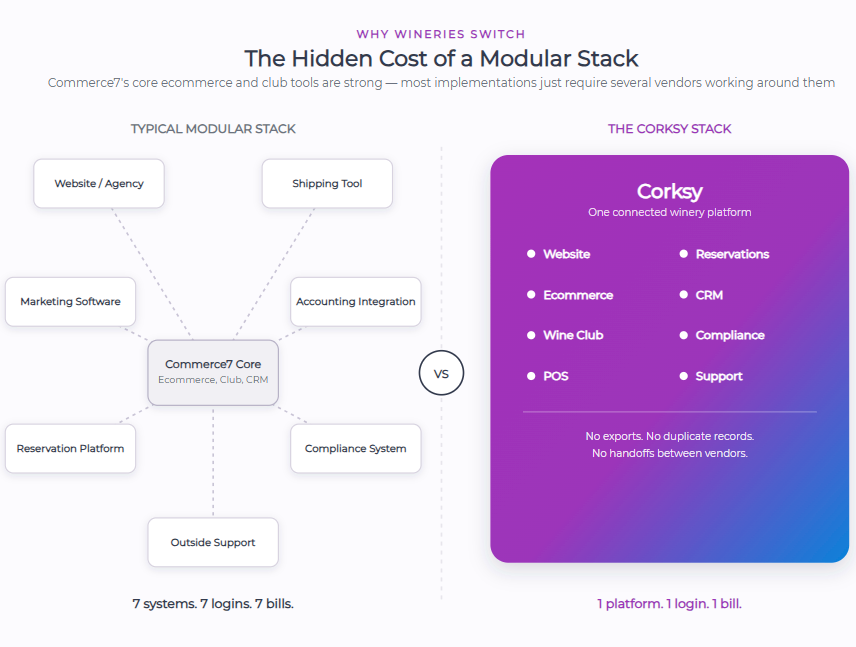
Commerce7 is one of the strongest and most recognized winery DTC platforms. Commerce7 includes native POS, ecommerce, wine clubs, reservations, CRM, and reporting. Where Commerce7 differs is that many wineries extend those core capabilities with a broad ecosystem of partners for websites, marketing, fulfillment, accounting, and other operational needs.
Commerce7 may be a good fit for wineries that:
Corksy may be a better fit for wineries that want to consolidate more functions under one platform and support relationship.
Commerce7 is commonly implemented as part of a broader winery technology stack.
That stack may include:
Corksy’s position is more consolidated. The website, ecommerce, wine club, POS, reservations, CRM and operational workflows are designed to work as one winery platform.
Based on Corksy’s recorded sales and customer conversations, common considerations include:
Commerce7 remains a strong option for wineries that value its partner ecosystem and modular structure. Corksy is positioned for wineries that would rather manage fewer systems, bills and vendor relationships.
OrderPort is an established winery software provider offering POS, ecommerce and wine club functionality.
For some wineries, OrderPort’s greatest advantage is familiarity. Staff may already understand the system, existing workflows may be built around it and its headline pricing may appear competitive.
Corksy’s strongest differentiation is modernization and operational simplicity.
Concerns recorded in Corksy sales conversations have included:
These experiences will vary by winery and should not be treated as universal OrderPort performance.
However, they point to the areas wineries should evaluate carefully during a platform comparison.
Corksy provides:
OrderPort may remain a reasonable fit for a winery that is comfortable with its existing setup and does not want to change established processes.
Corksy becomes more compelling when the winery’s main goal is reducing administrative work, improving usability and connecting the website more directly to the rest of the business.
Shopify is one of the most capable general ecommerce platforms available.
It has a mature website and ecommerce ecosystem, a large application marketplace and extensive support for traditional retail brands.
For wineries, however, ecommerce is only one part of the DTC operation.
A winery also needs to consider:
Shopify can support wine sales, but winery-specific functionality often requires additional applications such as a wine club app, compliance solution, reservation system and specialized POS or operational tools.
Shopify is an ecommerce platform that can be adapted for wineries.
Corksy is a winery platform that includes ecommerce.
That distinction should drive the comparison.
VinSuite is a longstanding winery software provider with tools for wine club, POS, ecommerce and customer management.
Corksy’s most direct competitive evidence against VinSuite is related to wine club operations.
A Corksy customer specifically described Corksy’s wine club tools as significantly better than the winery’s previous VinSuite experience. The customer highlighted wine club functionality as a major factor in the decision to switch.
Because there is limited broader competitive deal data, wineries should avoid assuming that one customer’s experience applies to every VinSuite implementation.
The most useful comparison is focused on current wine club needs.
Wineries evaluating Corksy and VinSuite should compare:
Corksy is likely to be most compelling when the winery’s current wine club process requires substantial manual work or is difficult for staff and members to manage.
Active8, also referred to in some winery conversations as Activate, can be a strong operational system for wineries that are satisfied with its core workflows.
In at least one Corksy sales conversation, the prospect described the system as working very well operationally.
That makes this a more specific comparison than a broad replacement argument.
The strongest opening for Corksy is typically around:
A winery that is happy with Active8 should first identify the exact operational gap it is trying to solve.
If the problem is limited to checkout or website experience, the winery may not need to replace its entire operational system.
If the problem is broader fragmentation across ecommerce, POS, club, CRM, website and reservations, Corksy’s unified model becomes more relevant.
VinoShipper is not always a direct Corksy competitor.
For many wineries, it is a compliance and market-access partner that can operate alongside another winery system.
VinoShipper can be particularly useful when a winery prioritizes:
Corksy’s role is broader across core winery operations, including:
A winery may use Corksy as its primary DTC operating platform while maintaining a separate VinoShipper workflow where additional shipping reach is necessary.
The right decision depends on whether the winery’s primary need is compliance reach or full operational management.
Integrations can expand what a winery platform can do.
They can also add cost, complexity and additional points of failure.
A winery should evaluate:
Corksy supports integrations for areas such as:
The Corksy model is not to eliminate every integration. Specialized tools remain valuable.
The goal is to reduce unnecessary fragmentation by keeping the core winery operation in one platform.
The quality of winery software depends partly on the team implementing and supporting it.
Wineries should ask:
Corksy provides in-house winery support and implementation assistance.
Corksy Complete adds ongoing marketing, website and ecommerce services for wineries that need execution beyond technical support.
Other platforms may rely more heavily on certified partners, agencies or outside developers. That model can provide access to highly specialized experts, but it also introduces additional vendor relationships.
Neither model is universally better. The winery should decide whether it wants to coordinate multiple specialists or work through a more consolidated relationship.
AI is becoming increasingly useful in winery operations, but the quality of AI output depends on the quality of the underlying data.
Potential winery AI applications include:
Before choosing software based on an AI feature, wineries should ask:
Corksy’s advantage is the foundation: connected customer and transaction data across winery operations.
As Corksy expands its analytics and AI capabilities, that connected dataset can support more meaningful recommendations than AI tools working from a limited portion of the customer relationship.
The value of AI is not the label attached to the feature. It is whether the winery can use the result to make a better operational or marketing decision.
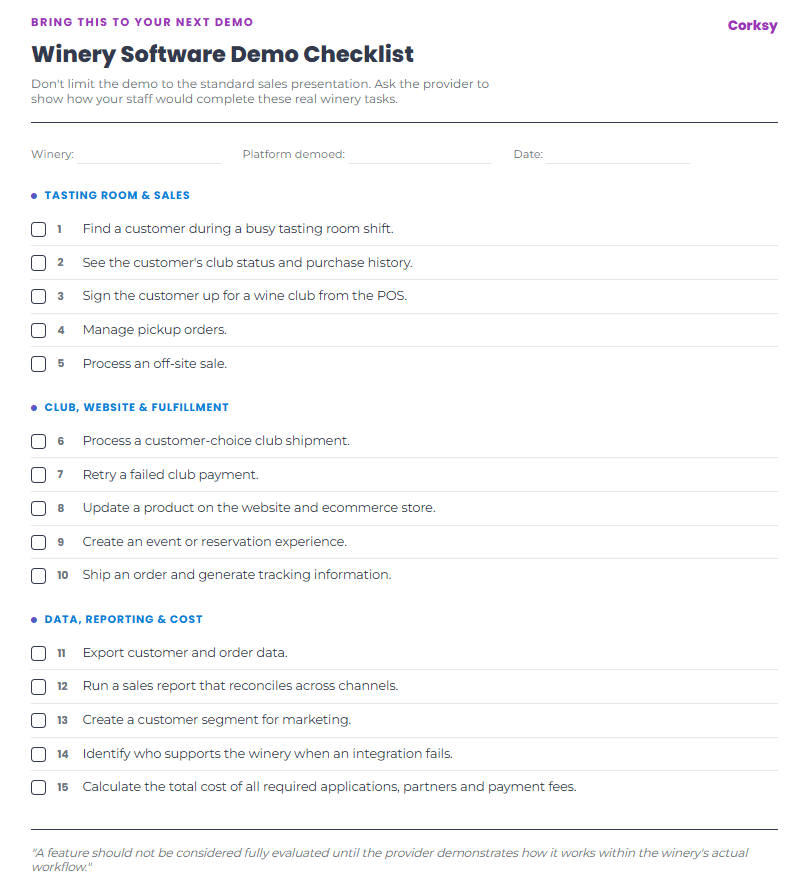
Do not limit the demo to the standard sales presentation.
Ask the provider to show how your staff would complete real winery tasks:
A feature should not be considered fully evaluated until the provider demonstrates how it works within the winery’s actual workflow.
The best winery software depends on the winery’s operating model. Corksy is a strong choice for wineries seeking one connected platform for website, ecommerce, wine club, POS, CRM, reservations and DTC operations. Commerce7 is strong for wineries that prefer a modular platform and partner ecosystem. Shopify is strong for retail-focused ecommerce but usually requires additional winery-specific applications.
The best wine club software should support flexible club structures, member self-service, customer-choice shipments, payment processing, failed-payment recovery, member pricing and reporting. Corksy connects wine club activity directly to POS, ecommerce, CRM and reservations. Commerce7 is another established wine club option with a broad integration ecosystem.
The best winery POS connects transactions to club status, customer history, member benefits, inventory and CRM data. Corksy POS and Corksy Go are built specifically for tasting rooms, winery events and mobile selling. General retail systems may require additional applications to support traditional winery club and compliance workflows.
Shopify can be a strong choice for retail-focused wine brands that prioritize ecommerce flexibility. Traditional wineries often need additional applications for wine club, compliance, reservations and specialized tasting room operations. Corksy provides those winery-specific functions within the core platform.
Commerce7 provides substantial winery ecommerce, club and customer-management functionality. Many wineries use it as part of a broader stack that includes separate website, marketing, shipping, compliance and service providers. Corksy’s differentiation is bringing more of the winery website and DTC operation under one platform and support relationship.
An all-in-one winery platform connects major DTC functions such as ecommerce, wine club, POS, CRM, reservations, website management, inventory, fulfillment and reporting. The purpose is to reduce duplicate data, manual handoffs and the number of systems staff must manage.
Usually not. Wineries may still need specialized tools for compliance, advanced marketing, shipping, accounting or analytics. The goal of an all-in-one platform is not to eliminate every specialized integration. It is to keep the winery’s core customer, order, product and operational data connected.
The total cost includes more than the base software subscription. Wineries should calculate website fees, applications, payment processing, integration costs, support, development, migration, hardware and staff time. A platform with a lower monthly fee may cost more overall if it requires multiple additional systems or extensive manual work.
A winery should evaluate data migration, staff training, payment processing, website management, club workflows, reporting, integrations, customer support and data portability. The provider should demonstrate the winery’s real workflows rather than relying only on a standard feature presentation.

Corksy’s clearest difference is not one isolated feature.
It is the ability to operate more of the winery’s direct-to-consumer business in one connected, wine-specific platform.
Commerce7 is a strong choice for wineries that value a modular platform and broad partner ecosystem. Shopify is a strong general ecommerce platform for retail-driven brands. OrderPort, VinSuite, and Activ8 may continue to serve wineries whose existing operations are stable and familiar. VinoShipper can be valuable when compliance reach is the primary need.
Corksy is built for wineries that want to connect the website, ecommerce store, wine club, tasting room POS, reservations, CRM and customer data—and reduce the operational burden created by separate systems.
The best way to compare winery software is to walk through your actual workflows.
Schedule a Corksy demonstration to see how your winery could manage its website, ecommerce, wine club, POS, reservations and customer data in one connected platform.